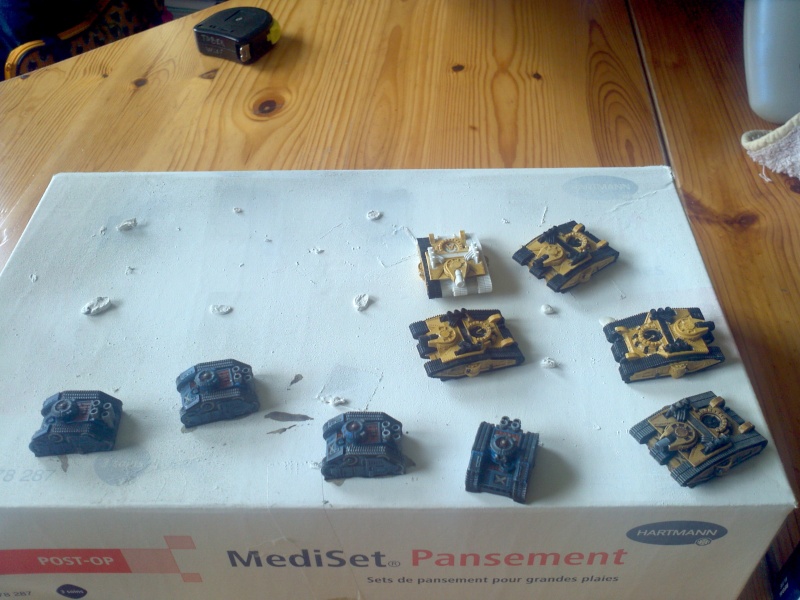
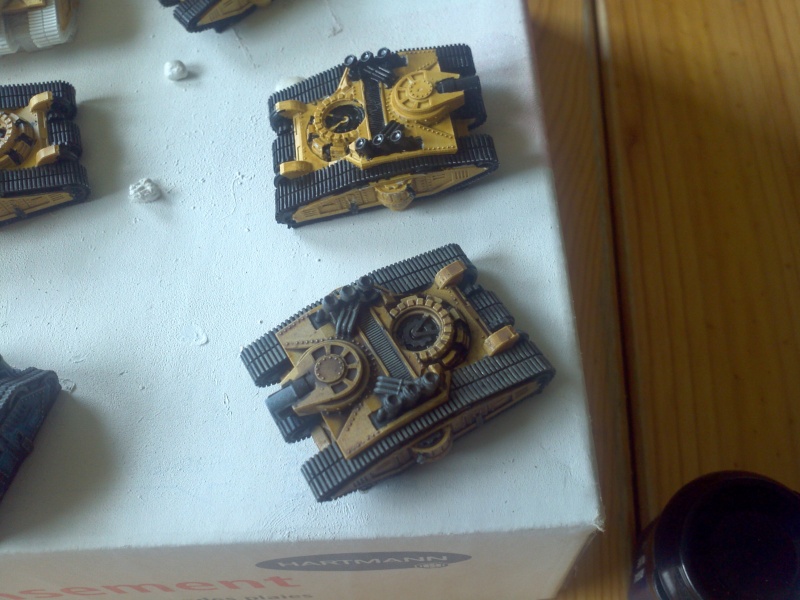
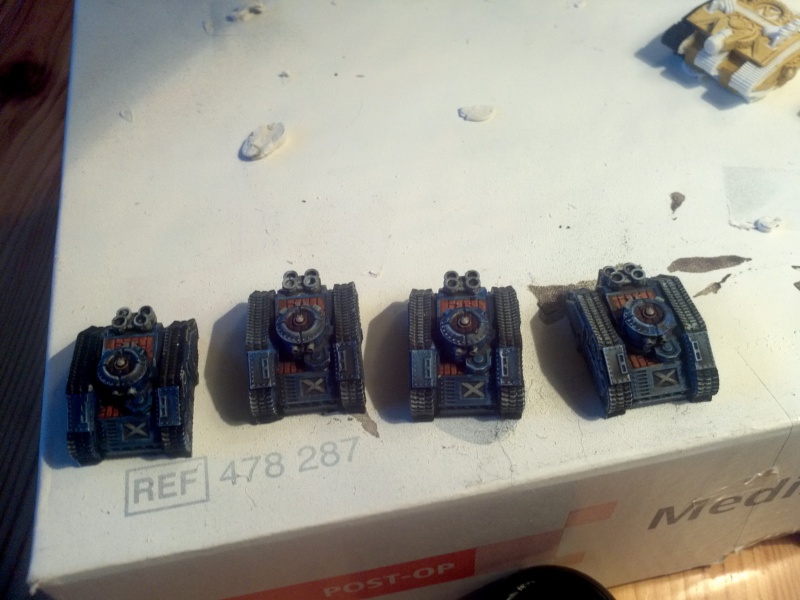
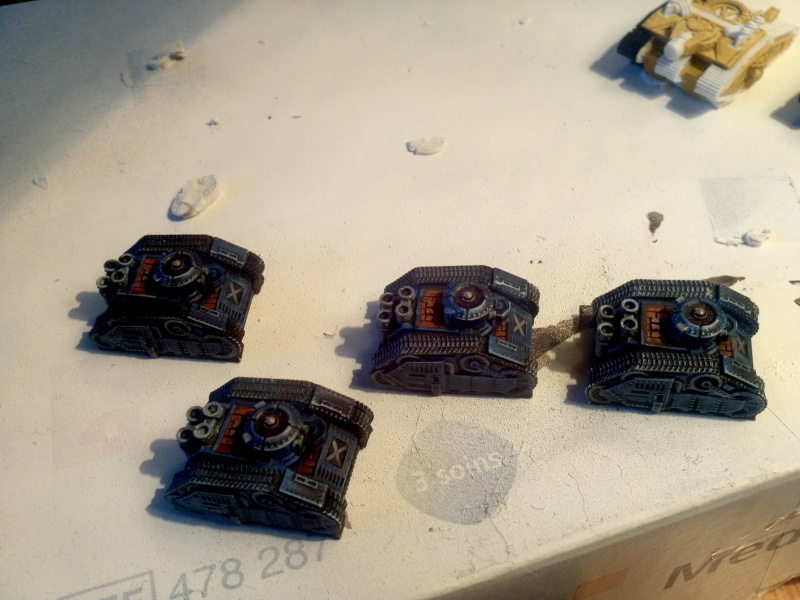
ah bon ? je croyais qu'il n'y avait que des regles moi dans ce bouquin ^^
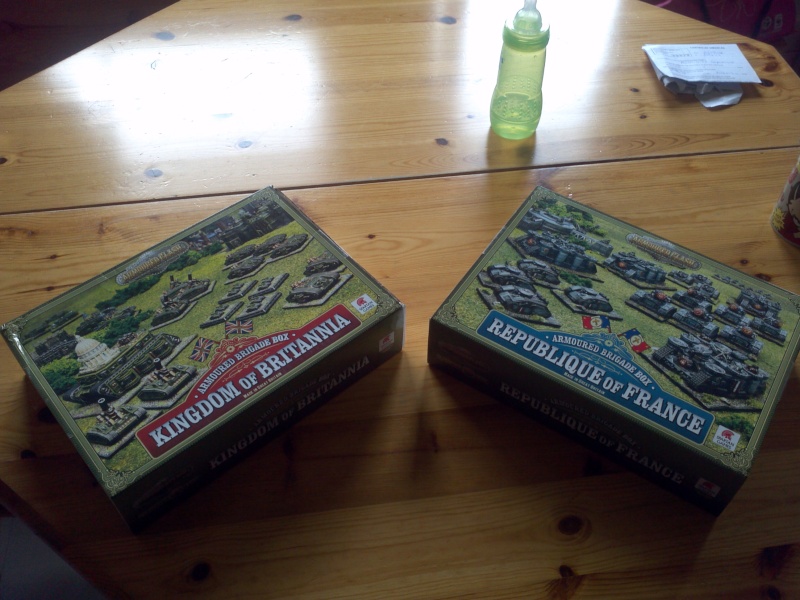
sinon pour avoir un peu de back voici un rapide survol de l'armée française ! in english only sorry

Republique de France
RECENT MILITARY DEVELOPMENTS
The French military was shattered by the wars that raged across Europe in the early 1800’s. Its army, having humbled Austria and Russia under Napolean Bonaparte, was scattered and broken after the Emperor’s assassination in 1804. Even its navy had suffered disproportionately; three-quarters of its ships-of-the-line were destroyed fighting the British at the Nile and again at Trafalgar. The end result of this is that, upon the opening of Wells Chasm and the unintentional arms race that act spurred, the French had the advantage of starting from scratch.
Nowhere else in the world was there a country that was able to rearm and innovate as rapidly and as effectively as the Republique of France. The French Army has been transformed from a minimalist force designed purely for national defense into a powerful armored formation capable of impressive feats of soldiering; the Navy was rebuilt almost entirely from the ground up and is now one of the most technologically advanced formations in the world. Lastly – and most impressively – the French have built their air force into perhaps the foremost such power on the planet.
Naval Developments
The French Navy (L’Armee de la Mer), prior to the 1850’s, was a relatively anemic branch incapable of force projection across long distances. It was built around just four ship classes, and was deployed in penny-packet squadrons primarily stationed along the Bay of Biscay and the Cote d’Azure. The ascension of Louis-Napolean Bonaparte to the presidency combined with the French raiding of Markov’s stolen documents led to a massive construction program for the French Navy in particular; with French territorial integrity guaranteed by the armored might of the Prussian Empire, President Bonaparte chose to focus on first upgrading his navy and so challenge the traditional French enemy, Britannia.
The old Ile de France-class battleships were the first target of this upgrade program, and the first Magenta-class battleships were launched for trials from the shipyards at Brest, Brittany in 1866 as proof-of-concept vehicles for the new Gravity Nullification Engine. The success of this vessel energized the Navy’s bureau of construction, and within three years the Navy’s on-hand manpower had increased by a factor of ten and its actual strength in warships by a factor of six. Now, the GNE, heat lance, and cloud generator have made the French Navy an extremely potent force.
Army Developments
The French Army (L’Armee de Terre) had begun to modernize before Bonaparte’s ascension; in this case, the Prussian Empire sought to strengthen their ally in order to ensure the security of their own flanks against Britannian invasions. Despite being equipped with armor of all weight classes, the French Army remained in essence a “fortress” force. Their tactics revolved around counter-thrusts protecting static fortifications along the Channel Coast, the Alpine frontier, and the Pyrenees Range.
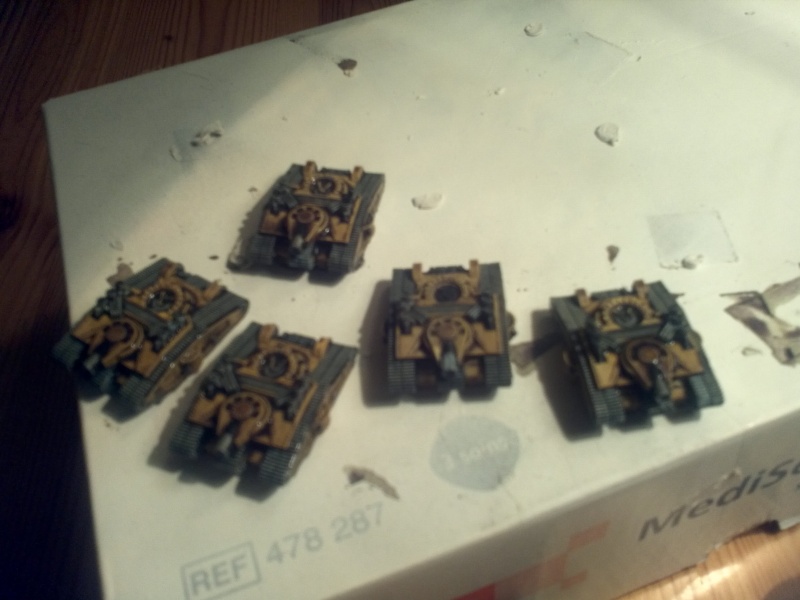
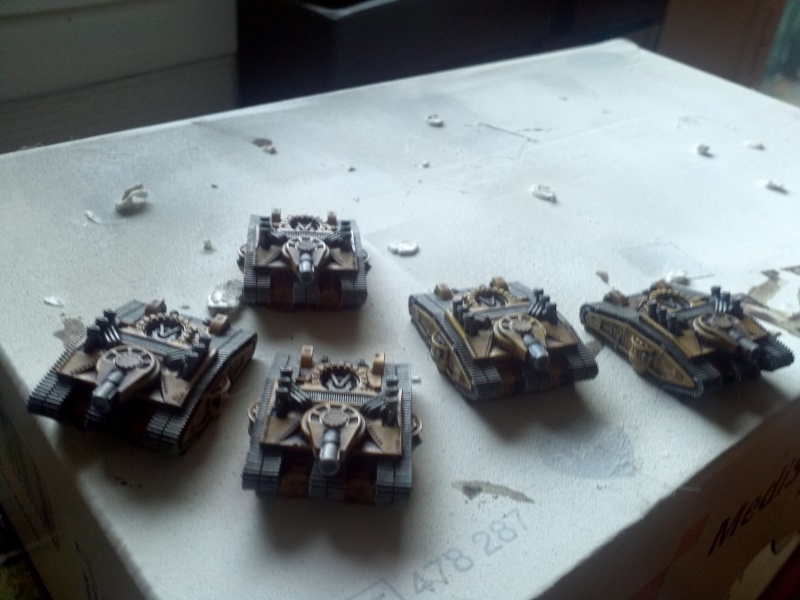
Perhaps the single greatest contribution that Bonaparte and Markov made to the French ground forces was the Bastille-class landship. Protected by a cloud generator and carrying one of the feared heat lances, these new landships replaced the earlier Valenciennes-class landships which, while heavily armed and armored, were extremely slow and prone to mechanical failure. The Bastille, as well as an upgrade program for the Focault-manufactured fleet of medium tanks that increased both their speed and firepower, catapulted the French land forces into the same power-bracket as the rest of the major powers and vastly increased France’s prestige in the eyes of the world.
Aerial Developments
The French Air Force (L’Armee de l’Air) was basically non-existent prior to 1847. In order to provide their military with some semblance of air support, the ruling Gaulois party undertook a limited development program in association with their Prussian allies. The result of this program was the Furieux-class scout airship, a conventional armored blimp in the Prussian style. The Mousketaire variable fightercraft was a byproduct of this program and the first sign that French aerospace engineers were capable of thinking further outside of the box than those of other nations.
Since the perfection of the GNE – and other scientific advancements in the field of propulsion – the French Air Force has grown by leaps and bounds. Powered by an aircraft industry almost unrivaled in the world, the French have utilized such power-house combat designs as the compact Voltaire interceptor and the mighty Vauban-class sky fortress to assert themselves as the preeminent aerial power in Western Europe.
NAVAL TECHNOLOGY REPORTS
Magenta-class BB: The Magenta-class battleship classes, despite being new and advanced designs, are actually somewhat dated. As a time-saving measure when the Magenta prototype was being planned, it was decided to use the previous Ile de France-class battleship as the base for the new vessel. To increase speed, the raised “B” turret and forecastle were removed and the mainmast moved forward, making room for a fourth funnel, more turbines, and the GNE equipment. The result of this was a faster, more maneuverable craft at an expense of firepower. With the prototype design proving extremely popular with its commanders, it was put into full production in two marks. The Mk. I featured extra fuel bunkerage and a GNE, while the second lacked the GNE but used the extra power production capacity of the ship’s engines to increase speed and power a prow-mounted heat lance.
The agedness of the design can be found in its secondary armament. Its broadsides are visibly different from the more modern vessels in the French fleet; rather than using the newer, short-barreled 164mm guns that are mounted on every other capital-class ship in the French fleet, they maintain the older, less-powerful 138mm guns mounted in individual deck- and hull-mounted gun turrets. These guns, in addition to being weaker than their replacements, vary in height above the water line and do not have a regular spacing along the length of the hull which in turn makes fire coordination for the broadsides extremely difficult.
Despite being the primary capital combatant for the Armee de la Mer, the Magenta has received few upgrades since the beginning of hostilities. While many ships of the class – of both marks – received cloud generators, its armament has not kept pace. Its broadside turrets remain difficult to use and are easily knocked out by enemy gunnery, and one expected upgrade (being the addition of the applique-type “retardant” armor) has not been forthcoming. This has resulted in the Magenta being relegated more and more to secondary postings while fleet commanders come to rely on the newer and more powerful ship classes such as the Charlemagne-class DN and Couronne-class CVA.
Charlemagne-class DN: The heaviest hitter in the French fleet, the Charlemagne-class represents a departure from the international standard of dreadnought design. Every other nation’s dreadnought design (including our own) is a duelist, designed to target a single other large vessel and destroy that target. The Charlemagne, however, is designed as a line-breaker; its firepower is dispersed into its two broadside arcs in order to deliver heavy damage across multiple targets. This concept has proven effective in combat, with the Charlemagne capable of acting both as a “bully” against multiple smaller enemy ships and still able to inflict massive damage on a single target.
This design concept, however, may not have been intentional. The first hulls of the Charlemagne-class were originally lain down as a new type of aircraft carrier in 1851. Lack of funding saw construction halt on these “Type-A” carriers at Brest and Cherbourg, although work continued on the hull at Dunkirk for several more months. These ships were originally designed to be catamaran-style fleet carriers, lightly armed but heavily armored and carrying a massive number of strike craft.
The hulls languished until 1865, when President-Elect Bonaparte ordered them redesigned as dreadnoughts. This complete redesign included the addition of the new hull-mounted “164mm-short” batteries on the broadsides and four twin-turrets (one fore, two abeam, one aft) mounting large-bore 380mm guns. The design continued to be refined and added to as work progressed, however. When the heat lance graduated from the test phase sometime in early 1867, the decision was made to replace the two beam turrets with heat lances instead, decreasing the vessel’s long-range firepower but giving it a devastating short-range battery. When the cloud generator was certified combat-ready in December of the same year, provision was also made for these. An additional armament consisting of four omni-directional rocket launchers was also added to the main-mast before the first vessel – the Charlemagne herself – left Dunkirk. But even then, changes were still in the wind; when French engineers perfected their retardant armor plating in March of 1869, all extant examples of the ship were recalled and retrofitted. The latest examples produced in the last six months also feature fury generators.
The resulting ship is a lethal combatant on the open seas, and suffers not at all from the rather slap-dash nature of its construction.
Couronne-class CVA: When the still-under construction Type A carrier hulls were converted to dreadnoughts in 1865, the French admiralty immediately requested that new plans be drawn up for an aircraft carrier capable of effectively supporting the new super-battleship. The most expedient method was used: simply cutting the original Type A in half lengthwise provided a tough carrier design capable of operating a similar amount of aircraft as the much larger Britannian Avenger-class. While President Bonaparte approved of the idea in theory, he wanted a carrier that was more than just – in his words – “a floating airfield.”
The redesign kept many of the features being installed on the ship’s parent design, including the secondary battery of 164mm-short guns, a cloud generator, retardant armor, a rocket battery, and even a prow-mounted heat lance. The final version of the Couronne entered full-pace production in 1868 with the lead ship in the class, the RFS La Gloire, certified combat-ready in January of 1869, some six months ahead of schedule.
The crews of the Couronne-class are especially highly-trained and deserve special mention. One of the limiting factors of modern aircraft carriers is the effect of gunfire on launching strike craft; the concussion of firing cannons, the smoke trails of rocket-engine ignition, and a dozen other factors associated with weapons-use make launching aircraft hazardous and thus every major nation suspends ordnance use during launch and recovery operations. The French Navy, however, trains every new pilot and carrier deck-crewman during simulations of these conditions. As a result, the Couronne is the only known class of aircraft carrier that has been documented as launching aircraft while firing its weaponry at full strength. This makes French carrier forces extremely flexible, and more lethal than their counterparts from most other nations.
Ecuyer-class CLE: The Ecuyer-class support cruiser is now the single oldest warship design in service with the Armee de la Mer. However, one should not mistake age for infirmity in this case. The Ecuyer (or “squire” in English) originally entered service in 1832 and comprised fully half of the French Navy’s warship strength by 1850. In that age, French naval doctrine sought slower, tougher warships; the Ile de France-class battleships were designated as the fleet’s heavy-hitters, and the Ecuyers designed to support them by keeping the skies clear of enemy aircraft. As a result, the Ecuyers are noticeably slower than the rest of the modern French cruiser force and much less well-armed.
Despite these drawbacks, the Ecuyers continue to be in high demand by the admiralty, and every Legion’s naval contingent contains multiple squadrons of them. Their primary armament is light by the measure of any nation’s cruisers, consisting of a single twin turret mounting 203mm rifled cannons in a forward emplacement with an extremely limited traverse. The design’s secondary armament, however, is why it is so highly prized. The afterdecks mount a total of six super-firing 20mm cannons capable of engaging aircraft at nearly double the range of standard anti-aircraft guns. These vessels indeed proved to be so important to the French doctrine of air superiority that they underwent a comprehensive retrofit in the early 1860’s that upgraded their fire coordination systems. These “new” Ecuyers are capable of unleashing devastating anti-aircraft firepower at long range and with a level of accuracy that is rarely encountered elsewhere.
Marseilles-class CL: The Ecuyer-class, while certainly a force multiplier for a battle fleet, lacked the kind of ship-to-ship damage capability that the new Armee de la Mer needed from its most numerous ship of the line. Another new construction program was initiated, this one intended to produce for the Republique a front-line cruiser capable of going toe-to-toe with the ubiquitous Tribal-class of the Royal Navy.
Early on, the decision was made that the Gravity Nullification Engine would be used – if it could be scaled down successfully. Although initially assumed to be a technological hurdle, lead scientist Gaston Brocard (Editor’s Note: Brocard was the man who turned our Cyclonic Thrust Engine into the Cloud Generator, an effective piece of technology we recently copied for use on the Arronax Project; attempts to extract him to Wells Chasm should be made.) was able to achieve this in record time. The resulting Marseilles-class is of nominal tonnage for a cruiser, and its “skimming” ability gives it high speed, great maneuverability, and the ability to sail over land.
Interestingly, it was also the test bed for the retardant armor concept. Although we continue to research what few examples we’ve recovered from the battlefield, the secret of retardant armor so far escapes our engineers. The best guess as to how it functions is that additional armor plates of aligned-crystal steel are applied to the belt armor of the warship. These plates are not solid, however; they are instead honeycombed, allowing the air pockets within the armor to help diffuse the forces of impact and detonation without substantially adding to the mass of the warship.
The Marseilles is armed with a single turret mounting a single 340mm gun, itself an attempt to scale back the standard 380mm gun to a size more manageable for the smaller hull of a cruiser. Its secondary armament consists of the standard 164mm-short battery, mounted in single-gun barbettes along the hull. Although this is a relatively light weapon load for a ship of the line, the French admiralty approved the vessel on the basis that it was well-protected against its intended rival, the Tribal, even if the class was slightly undergunned.
Toulon-class CA: The Marseilles- and Ecuyer-class cruisers are both useful in their own ways, but both lack a heavy damage-dealing capability. This lack was apparent to the Republique Admiralty and so, in early 1869, with the naval re-armament program in full swing, a new cruiser design was ordered. The new ship was required to have heavy firepower, good speed, and be heavily protected in order to operate well as a ship of the line.
The original proposals for the Toulon submitted by various shipyards tended not to meet these requirements. They either overloaded on gun turrets and armor, slowing the vessel down too much, or their armament was too light. The discussion on which ship design to accept dragged on until French scientists revealed a scaled-down version of the new thermal lance. Although only half as effective as the original version, this new “lancette” was also smaller and had lower power requirements. This made it ideal for deployment on a cruiser hull, and the Toulon-class was born.
Although fast and well-protected, the Toulon still suffers from several flaws in design and employment. They have yet to be produced in significant numbers and published French doctrine dictates that they are employed in pairs, which limits the potential of the heat lancette. The lancette’s mounting also features a very limited traverse, impeding the Toulon’s ability to utilize its speed to perform broadside attacks.
Lyon-class FF: The Lyon has served as the workhorse of the Armee de la Mer since the late 1840’s. It is a surprisingly simple and extremely austere design that nonetheless featured a very important mechanic that French designers would continue to utilize for years to come. When the Lyon-class was first being designed, it was conceived as a knife fighter; its mission was to close with enemy screens and engage them at literally point-blank range. To this end, and as a space and cost saving measure, it was designed with six short-barreled 164mm guns, three to a side, in armored casemates rather than utilizing deck-mounted turrets. Although the 164mm guns are relatively low-velocity and thus of comparatively short range, the position of the casemates along the hull and below the deck means that if they penetrate the hull of a ship, they provide a greater chance of forcing the enemy to take on water. Aside from the possibility of sinking or capsizing, this also means that so-affected enemy ships may lose speed and maneuverability. This design feature proved so successful that the 164mm-short and its casemate system has become a standard design feature on all subsequent warships as well as airships in French service. It is not a perfect system, however, since at high speed or in high seas the casemates have a tendency to take on water as well, although bilge pumps are largely successful at mitigating this problem.
Aside from its primary armament, the Lyon is a solid if uninspiring design. It was extremely well armor for a frigate, and its secondary torpedo battery provides a solid weapon system while closing on a target. Like all French vessels of its time, it is comparatively slow and can be fairly easily outpaced by its preferred enemy, the Britannian Attacker-class.
Alma-class FF: The latest addition to the Republique’s navy is the Alma-class frigate, which represents another giant leap forward in French technology. The Alma features the next stage of miniaturization for the Gravity Nullification Engine, making it the smallest naval vessel capable of, as French sailors put it, “sailing the hard ocean.” The Alma, although not intended as a replacement for the ubiquitous Lyon, nonetheless is an improvement on that venerable design in many important ways. Both vessels are well-armored for their size, but the Alma’s GNE and skimming design make it faster and more maneuverable than its predecessor. The Lyon has more guns and is capable of engaging enemies in almost every arc of fire; the Alma, by contrast, has only a single weapon system. However, this single gun – in this case, a single mounting of the Ecuyer’s 203mm rifled cannon – has a greater range and hitting power than the 164mm-shorts of the Lyon and its turret is capable of 360 degree rotation. This combination of maneuverability, toughness, and flexible firepower make the Alma an ideal raider, capable of bypassing minefields and coastlines in order to penetrate into an enemy’s interior. Indeed, entire battlegroups of these “sea skimmers” operated with near impunity during Operation Lion de la Mer, striking inland targets with ease while being largely immune to the English countryside’s land-based defenses.
Chevalier-class DD: In mid-1869, with its rearmament program in full swing, naval strategists in Paris noticed that their fleet was dangerously close to being too short-ranged across the board – a concept exacerbated by an early over-reliance on heat lances by naval commanders. To counter this, a new design was requested to correct this range gap. Initially conceived as a light cruiser, planners believed it would take too long to design, test, and manufacture the new ship in appropriate numbers in the short amount of time available due to the outbreak of war. The compromise solution was to modify the Lyon-class frigate’s hull, removing its current weapon systems and reducing the size of its engine. The result was the Chevalier-class destroyer. The Chevalier (knight) mounts a single rocket battery in a limited-traverse mounting, lacking any barbette whatsoever. While these vessels pose little threat individually, when utilized en masse, they are capable of laying down a veritably rain of high explosives that have proven capable of inflicting severe damage on heavy cruisers and even battleships at long range. Exacerbating this threat are the dictates of French doctrine, which exploits this capability by teaching Chevalier crews to work in concert, increasing the overall effectiveness of the weapon system by saturating enemy point-defense.
Epaulard-class SSB: The pre-war French naval doctrine of concentrated defense using large battlegroups of slow, but well-armored ships resulted in many gaps in the defense of the French coastline. These battlegroups lacked the speed to conduct anti-piracy and anti-smuggling operations and, in the event of an invasion from the sea, would not be able to react in time, with enough force, to repel an attack. To fill this gap, the French designed the Epaulard-class bombardment submarine.
Named after the orca, the Epaulard was designed for long-distance patrols of French shores, with small squadrons working independently of surface commands. As a predominantly anti-pirate and anti-invasion weapon system, they are designed to approach by stealth and shower an enemy with warheads from their onboard mortars at extreme ranges with little or no warning. This capability has also been used in conventional naval battles with the Britannians off of the coast of North Africa, and as a preliminary shore bombardment tool during the initial landings and recovery efforts during Operation Lion de la Mer. Its minelaying capacity, while small, has also proven successful at disrupting merchant shipping in the Western Approaches, and as a shore protection measure. The vessel itself is also small enough and light enough to be slung under Furieux-class airships, making it ideal as an ancillary vessel when supporting skimming fleets that must first cross land when breaking out of (or into) restricted waters.